Technical Product Marketing & GTM for Cybersecurity, B2B Tech & Applied AI
Cybersecurity Decision System by Tush Nikollaj and Nikolay Gul
Latest Book · Cybersecurity Leadership Series — Book 2

Cybersecurity Decision System

How Leaders Manage Cyber Risk, Trade-Offs, and Resilience

By Tush Nikollaj & Nikolay Gul

A practical leadership system for turning cybersecurity complexity into clearer decisions, stronger evidence, better trade-offs, and more resilient operations under real business constraints.

Tush Nikollaj & Nikolay Gul Paperback · eBook · Audiobook September 2026 Future-Proof Marketing Press

Security Is Not a Product. It Is a Decision Discipline.

Cybersecurity becomes a leadership problem when technical signals, operational pressure, vendor dependencies, financial trade-offs, and incomplete evidence collide.

A business does not become resilient because it buys another tool, reads another report, or holds one security meeting. It becomes more resilient when leaders can turn information into an explicit decision, assign ownership, preserve evidence, and know when that decision must be challenged again.

This book does not try to turn executives into cybersecurity engineers. It gives owners, executives, boards, and technology leaders a practical operating language for risk, continuity, evidence, accountability, and recovery.

The coauthored edition combines practitioner experience in managed IT and cybersecurity leadership with a decision-system approach to complex technology choices.

The result is a business-centered system built around a simple leadership rhythm: see what matters, decide deliberately, prove what supports confidence, practice failure, and repeat as conditions change.

New in the Coauthored Edition

Two complementary perspectives. One operating system for cyber decisions.

Tush Nikollaj brings more than three decades of technology, managed-services, operational-risk, and cybersecurity leadership experience. Nikolay Gul brings a decision-system approach focused on turning complex technology topics into usable frameworks, stronger questions, and evidence-based business decisions.

The shared objective is practical: help leaders make cybersecurity decisions that remain understandable and defensible when conditions become difficult.

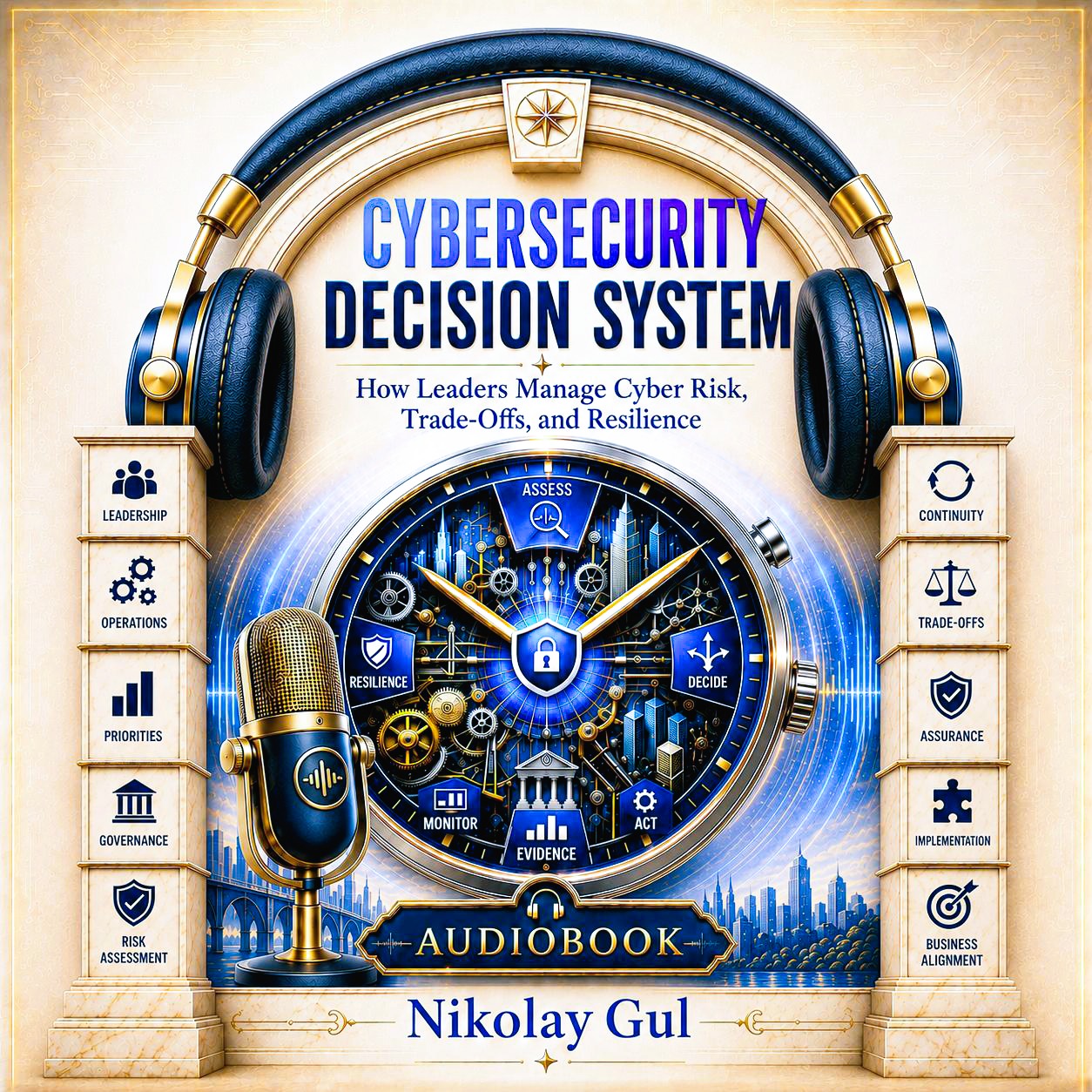
Cybersecurity Decision System audiobook by Tush Nikollaj and Nikolay Gul

Book Highlights

A leadership-focused guide to the decisions that determine whether cybersecurity works under real business conditions.

Cybersecurity as a Decision Discipline

Move beyond product lists and dashboards by making ownership, evidence, trade-offs, and review points explicit.

Cyber Risk Economics

Translate disruption, delay, recovery uncertainty, and preventative controls into business language leaders can compare.

AI, Deepfakes & Verification

Establish practical verification rules for sensitive actions and govern AI use without blocking useful experimentation.

Vendor & Shared Responsibility

Clarify what the organization owns, what providers own, and where assumptions can create dangerous gaps.

Evidence Before Pressure

Build a Trust Evidence Pack and Decision Ledger before insurers, auditors, customers, or incidents force the questions.

90-Day Readiness & Failure Practice

Use a focused readiness sprint and rehearsed recovery to replace vague confidence with visible evidence.

Executive Audio & Media Briefings

Use these short-form resources to understand the operating logic of the book before, during, or after reading it.

Executive Crash Course

Cybersecurity Decision System Executive Crash Course by Tush Nikollaj and Nikolay Gul

Cybersecurity Decision System - Executive Crash Course

A compressed leadership briefing built around the book’s core decision model.

Bonus: The Control Tower Principle

Cybersecurity Decision System by Tush Nikollaj and Nikolay Gul — Control Tower Principle audio cover

A Leaders Guide to Managing Cyber Risk

An analogy for coordinating visibility, decisions, continuity, and accountability without stopping the business.

The Cyber Risk & Cost-of-Delay Calculator

Based on the book’s cyber-risk economics approach. Compare the cost of operational disruption with the upfront cost of a preventative control.

1-Hour Impact
$0
1-Day Impact
$0
1-Week Impact
$0

Key Terms & Frameworks Explained

A plain-language reference to the book’s distinctive operating terms, designed for leaders who want the concepts before the jargon.

1. The Decision Ledger

A durable record of important decisions, accepted risks, exceptions, owners, evidence, and review triggers so assumptions do not quietly become permanent risk.

2. The Trust Evidence Pack

An organized evidence base that helps the business answer serious questions from insurers, auditors, customers, and leadership before pressure arrives.

3. The 90-Day Readiness Sprint

A structured cycle for replacing vague confidence with visible readiness: see clearly, reduce avoidable risk, prove what matters, and establish the next review point.

4. The Continuity Trade-Off Card

A one-page record for critical processes where a security action could interrupt operations. It makes the protection-versus-continuity trade-off explicit before a crisis.

5. The Sensitive Action Rule

A verification rule for moments when trust becomes action, especially payments, credentials, sensitive data, privileged changes, or requests vulnerable to AI-enabled impersonation.

6. Boardroom Decision Brief

A compact format for showing material changes, evidence, decisions needed, ownership, and risks accepted or deferred without burying leaders in technical detail.

7. The Control Tower Principle

A leadership analogy: cybersecurity is not about grounding every flight. It is about maintaining visibility, coordination, evidence, priorities, and safe movement under changing conditions.

8. Assumption Expiration

A reminder that a decision can remain documented while the assumptions underneath it become obsolete. Important assumptions need explicit review triggers.

9. Failure Rehearsal

Practice for the moment a control, backup, vendor, identity process, or recovery plan does not behave as expected. Resilience requires evidence from tested failure, not confidence alone.

Control Tower Principle cybersecurity leadership infographic

About the Authors

Two perspectives focused on one objective: clearer, more defensible cybersecurity decisions under real operating constraints.

Tush Nikollaj

Coauthor · Technology Entrepreneur · Cybersecurity Executive

Tush Nikollaj is a technology entrepreneur, business leader, and cybersecurity executive with more than three decades of experience helping organizations navigate technology transformation, operational risk, and cybersecurity challenges.

As President and CEO of Logical Net Corporation, his work emphasizes clarity, accountability, measurable risk reduction, tested recovery, shared responsibility, and cybersecurity practices that function under real business conditions.

Nikolay Gul

Coauthor · Applied AI · Cybersecurity Decision Systems

Nikolay Gul writes about applied AI, cybersecurity, technology marketing, business decision-making, and practical technology adoption.

His work focuses on turning complex technology topics into usable systems, better questions, stronger evidence, and practical decisions, including books on AI prompting, AI implementation, cybersecurity purchasing, and technology marketing.

Together: Nikollaj and Gul combine practitioner experience with decision-system thinking to help business leaders turn cybersecurity complexity into clearer decisions, stronger evidence, and more resilient operations.

Edition & Registration Details

Current identifiers for the September 2026 coauthored edition.

Paperback ISBN979-8-9938806-3-1
eBook ISBN979-8-9938806-4-8
Audiobook ISBN979-8-9938806-6-2
LCCN2026922427
↑