Velocity Trap
When AI makes output faster, but the business becomes slower at trusting, reviewing, governing, or using the output.
How to Make AI Adoption Work in Real Business Systems
A Decision-First Field Manual for Reducing Rework, Controlling Risk, and Turning AI Speed Into Measurable Results
AI Implementation Blind Spots is a decision-first business field manual for leaders and operators who need AI to improve real workflows, reduce hidden rework, control risk, and create measurable business value after the demo ends.
Many organizations measure tool usage, content volume, pilots, and speed while missing review burden, exception cost, weak ownership, and unclear outcomes.
The book moves AI strategy from tool-based thinking to workflow, decision, evidence, ownership, risk, and financial translation.
Readers learn sharper questions for deciding which AI initiatives should scale, stop, continue testing, or be redesigned.
This video gives visitors a faster way to understand the book’s core promise: AI adoption should be judged by real business implementation, not by tool usage, speed alone, or pilot activity.
This book is about the implementation layer: workflows, decisions, ownership, risk, evidence, economics, pilot proof, and scale-or-stop discipline.
Most organizations think the AI implementation problem is a software problem. It is not. It is a decision design problem.
These public concepts help readers recognize where AI creates value, where it creates hidden work, and where a pilot needs stronger decision discipline before scale.
When AI makes output faster, but the business becomes slower at trusting, reviewing, governing, or using the output.
Visible AI activity — pilots, dashboards, demos, training, and tool usage — without enough evidence that the business system improved.
The hidden cost of verifying, correcting, reviewing, and managing AI output before it becomes trusted usable work.
The discipline of designing how decisions move through a business system when humans and AI work together.
The operating line between what AI may assist with, recommend, act on, escalate, or stop.
The hidden accumulation of operational liability when AI influences decisions without clear ownership, records, or escalation rules.
The real improvement left after review, correction, exception handling, ownership, and risk controls are counted.
The practice of deciding whether an AI initiative deserves scale, redesign, continued testing, or termination.
A workflow can look faster when AI produces the first output quickly. The real question is what remains after verification, correction, exception handling, and senior review are counted.
Net Gain = (Baseline Time − AI-Assisted Time) − (Verification + Correction + Exception Handling)
The first story says AI saved 70 minutes. The more honest story says the trusted net gain is 29 minutes after the hidden work is counted. That may still be valuable, but now the decision is based on reality.
AI value begins when AI improves a real workflow, supports a real decision, creates evidence, reduces hidden work, and fits inside ownership and risk controls.
It avoids vague transformation claims and focuses on the harder operating questions: what should AI improve, who owns the outcome, what evidence proves value, and what should not be automated.
Executives, operators, consultants, AI strategists, MSP and IT leaders, cybersecurity teams, finance leaders, GTM teams, founders, and practical decision-makers.
Chapter 1 introduces the Velocity Trap: the mistake of treating faster AI output as proof of business value before review burden, decision quality, and trusted usable work are counted.
Are we actually better? Did AI reduce real work, or move it somewhere else? After humans review and correct the output, does the workflow still improve?
This audio review gives visitors another entry point into the book’s central warning: faster AI output is not the same as better business performance unless trusted net gain, ownership, and decision quality are counted.
The hero uses the actual cover in a smaller fast-loading preview. This section keeps the larger cover image available for readers who want a closer look.
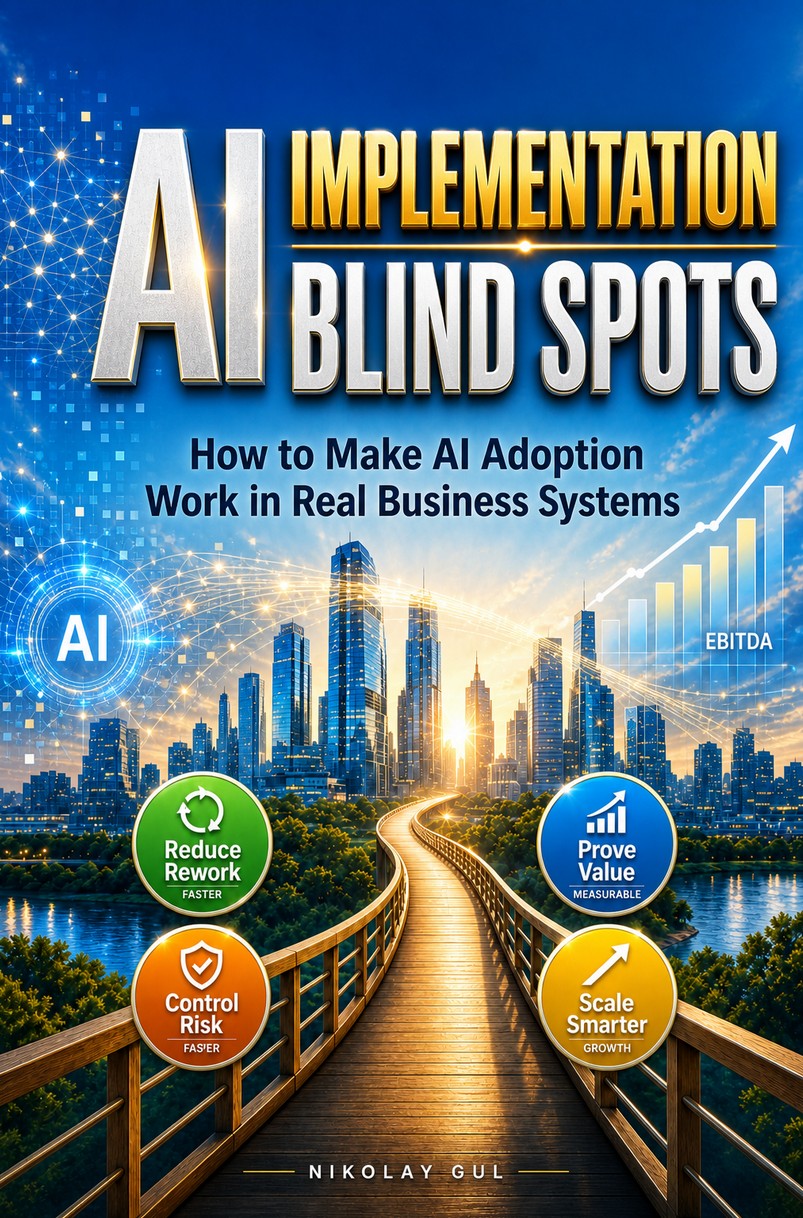
Click the cover to open the full-size image.
This GPT is positioned as a practical bridge between AI capability and business execution. It is useful for readers who want to think through use cases, workflows, decision boundaries, AI adoption risks, and practical implementation questions.
Open AI Strategy GPTThese answers are written for readers first. They also make the book’s subject matter clear to crawlers, assistants, and knowledge systems without exposing the full implementation toolkit before publication.
Separate AI activity from measurable implementation evidence before approving scale.
Translate AI into cost behavior, capacity, margin protection, risk-adjusted value, and defensible net gain.
Use practical language to connect tools, workflows, decisions, ownership, evidence, and business value.
Avoid weak automation around tickets, alerts, escalation, privileged users, sensitive assets, and response ownership.
Use AI to support buyer decisions and proof quality, not just to multiply generic output.
Recognize where AI creates hidden review burden, approval ambiguity, audit gaps, and Shadow Ledger exposure.
The companion resource pages may include editable worksheets, Rework Tax calculators, Decision Boundary prompts, Evidence Pack templates, pilot scorecards, and implementation planning materials as they become available.