Nikolay Gul - author of 6 books (3 Library of Congress entries) | Marketing & Advertising for Cybersecurity, Cisco Partners & High-Tech | AI-Enhanced Content, AI Prompt Engineering | GEO & AIEO | Creator of Proprietary AI Frameworks
Forthcoming 2026 AI strategy field manual

AIImplementationBlind Spots

How to Make AI Adoption Work in Real Business Systems

A Decision-First Field Manual for Reducing Rework, Controlling Risk, and Turning AI Speed Into Measurable Results

Decision-firstAI strategy, not tool hype
Workflow-awareDesigned for real operating systems
Evidence-ledBuilt for scale-or-stop decisions
Book summary

AI adoption is easy to start. AI implementation is harder to prove.

AI Implementation Blind Spots is a decision-first business field manual for leaders and operators who need AI to improve real workflows, reduce hidden rework, control risk, and create measurable business value after the demo ends.

The problem

Many organizations measure tool usage, content volume, pilots, and speed while missing review burden, exception cost, weak ownership, and unclear outcomes.

The operating shift

The book moves AI strategy from tool-based thinking to workflow, decision, evidence, ownership, risk, and financial translation.

The reader outcome

Readers learn sharper questions for deciding which AI initiatives should scale, stop, continue testing, or be redesigned.

Book video

Watch the short introduction to AI Implementation Blind Spots.

This video gives visitors a faster way to understand the book’s core promise: AI adoption should be judged by real business implementation, not by tool usage, speed alone, or pilot activity.

Positioning

Not a prompt guide. Not a vendor brochure. Not another AI hype book.

This book is about the implementation layer: workflows, decisions, ownership, risk, evidence, economics, pilot proof, and scale-or-stop discipline.

Central argument

Most organizations think the AI implementation problem is a software problem. It is not. It is a decision design problem.

Core ideas readers meet in the book

Practical language for separating AI activity from AI implementation.

These public concepts help readers recognize where AI creates value, where it creates hidden work, and where a pilot needs stronger decision discipline before scale.

Velocity Trap

When AI makes output faster, but the business becomes slower at trusting, reviewing, governing, or using the output.

AI Theater

Visible AI activity — pilots, dashboards, demos, training, and tool usage — without enough evidence that the business system improved.

Rework Tax

The hidden cost of verifying, correcting, reviewing, and managing AI output before it becomes trusted usable work.

Decision Architecture

The discipline of designing how decisions move through a business system when humans and AI work together.

Decision Boundary

The operating line between what AI may assist with, recommend, act on, escalate, or stop.

Shadow Ledger

The hidden accumulation of operational liability when AI influences decisions without clear ownership, records, or escalation rules.

Trusted Net Gain

The real improvement left after review, correction, exception handling, ownership, and risk controls are counted.

Scale-or-Stop Discipline

The practice of deciding whether an AI initiative deserves scale, redesign, continued testing, or termination.

Interactive concept

The dashboard shows speed. The workflow may hide the Rework Tax.

A workflow can look faster when AI produces the first output quickly. The real question is what remains after verification, correction, exception handling, and senior review are counted.

90 minBaseline work
20 minAI first draft
41 minReview + correction
29 minTrusted net gain

Net Gain = (Baseline Time − AI-Assisted Time) − (Verification + Correction + Exception Handling)

The first story says AI saved 70 minutes. The more honest story says the trusted net gain is 29 minutes after the hidden work is counted. That may still be valuable, but now the decision is based on reality.

Chapter roadmap

A field manual organized around real AI implementation failure points.

Chapter 1 — The Velocity Trap and AI Brain Fry
Why AI speed does not equal business value when review burden, cognitive load, and decision quality are ignored.
Chapter 2 — AI Theater vs. the AI Implementation Studio
How visible AI adoption can hide weak ownership, weak proof, and weak operating discipline.
Chapter 3 — The Rework Tax
Why verification, correction, exception handling, and senior review determine whether AI actually scales.
Chapter 4 — The Pilot Trap and the 40% Failure Pattern
Why a successful demo or pilot does not automatically prove production readiness.
Chapter 5 — Trust, Risk, and the Shadow Ledger
Why AI-influenced decisions need ownership, evidence, boundaries, records, and escalation paths.
Chapter 6 — The Death of Tool-Based Thinking
Why tools can enable AI adoption but cannot replace workflow and decision strategy.
Chapter 7 — The AI Strategist as a Decision Architect
The practical role organizations need to connect AI capability to business decisions.
Chapter 8 — EBITDA: The Financial Translation Layer
How AI connects to cost, capacity, revenue, margin, cash protection, and risk-adjusted value.
Chapters 9–14 — The Decision Architecture System
Workflow mapping, bottleneck prioritization, decision boundaries, pilot proof, and scale-or-stop discipline.
Chapters 15–18 — Enterprise System Playbooks
Revenue, operations, finance, cybersecurity, healthcare administration, and high-risk AI environments.
Part V — Compact Hard-Dollar Case Studies
Modeled cases showing how AI blind spots appear in MSPs, cybersecurity, marketing, finance, and AI portfolio decisions.
Part VI — The Decision Architect’s Toolkit
Concise tools for AI readiness, Rework Tax review, Real Velocity, decision boundaries, pilot scorecards, and implementation planning.
Quick answers

Short, direct explanations for readers, buyers, and decision-makers.

What is the book’s main idea?

AI value begins when AI improves a real workflow, supports a real decision, creates evidence, reduces hidden work, and fits inside ownership and risk controls.

What makes it different?

It avoids vague transformation claims and focuses on the harder operating questions: what should AI improve, who owns the outcome, what evidence proves value, and what should not be automated.

Who is it for?

Executives, operators, consultants, AI strategists, MSP and IT leaders, cybersecurity teams, finance leaders, GTM teams, founders, and practical decision-makers.

Interactive reader lens

Choose a role to see the book’s practical angle.

Executive angle: Use the book to separate visible AI activity from evidence-backed implementation decisions before approving scale.
Chapter 1 audio demo

Hear the first blind spot: speed itself.

Chapter 1 introduces the Velocity Trap: the mistake of treating faster AI output as proof of business value before review burden, decision quality, and trusted usable work are counted.

Listen for

Three questions behind the chapter

Are we actually better? Did AI reduce real work, or move it somewhere else? After humans review and correct the output, does the workflow still improve?

Audio review

Escaping the AI Velocity Trap.

This audio review gives visitors another entry point into the book’s central warning: faster AI output is not the same as better business performance unless trusted net gain, ownership, and decision quality are counted.

Book cover preview

Current cover direction for AI Implementation Blind Spots.

The hero uses the actual cover in a smaller fast-loading preview. This section keeps the larger cover image available for readers who want a closer look.
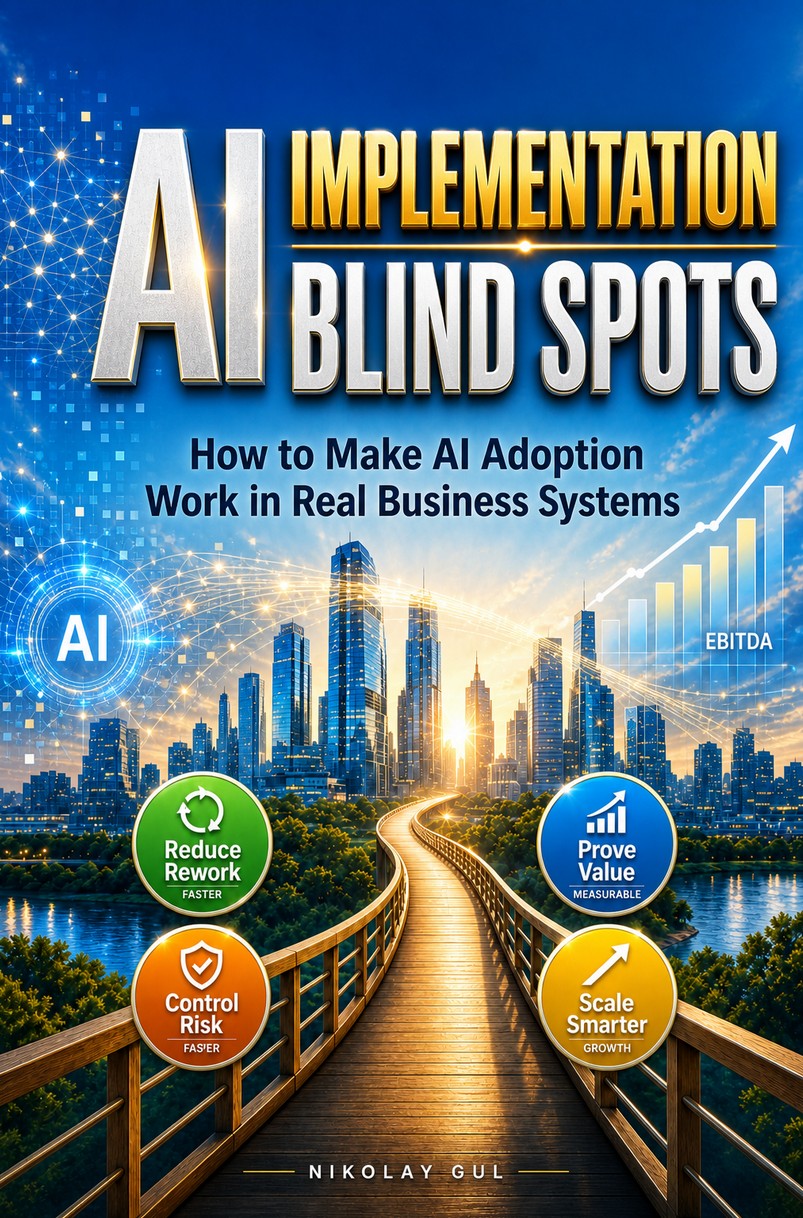
AI Implementation Blind Spots book cover by Nikolay Gul - decision-first AI strategy book

Click the cover to open the full-size image.
AI Strategist - AI to Business Practical Adaptation GPT by Nikolay Gul
Companion AI strategy tool

Explore the AI Strategist GPT for practical adaptation work.

This GPT is positioned as a practical bridge between AI capability and business execution. It is useful for readers who want to think through use cases, workflows, decision boundaries, AI adoption risks, and practical implementation questions.

Open AI Strategy GPT
Reader questions

Questions buyers, executives, AI strategists, and operators are likely to ask.

These answers are written for readers first. They also make the book’s subject matter clear to crawlers, assistants, and knowledge systems without exposing the full implementation toolkit before publication.

What is AI Implementation Blind Spots about?
AI Implementation Blind Spots is a business field manual about why AI adoption often creates activity without measurable value, and how organizations can make AI work through workflow discipline, decision ownership, Rework Tax reduction, Decision Boundaries, evidence, economics, and risk control.
Who should read this AI strategy book?
The book is written for executives, founders, AI strategists, consultants, MSP and IT leaders, cybersecurity teams, finance leaders, marketing and GTM teams, operations leaders, and anyone responsible for proving that AI creates real business value.
Is this a prompt engineering book?
No. This is not a prompt guide. It focuses on the business implementation layer: workflows, decisions, owners, risk levels, evidence, financial translation, pilot proof, and scale-or-stop discipline.
What is the Rework Tax in AI implementation?
The Rework Tax is the hidden operational cost of verifying, correcting, reviewing, and managing AI output before that output can be trusted inside a real business process. It helps leaders avoid mistaking first-output speed for finished business value.
What is AI Theater?
AI Theater happens when an organization performs AI adoption through pilots, dashboards, demos, training, tool usage, and internal announcements without changing workflows, ownership, risk controls, or measurable business outcomes.
What is Decision Architecture?
Decision Architecture is the discipline of designing how decisions move through a business system when humans and AI work together. It asks what AI can assist with, what it can recommend, what humans must own, and where the system must escalate or stop.
Why do AI pilots fail at scale?
AI pilots often fail at scale because the pilot proves possibility but not production readiness. Real deployment introduces ordinary users, messy data, integration cost, review burden, risk controls, exceptions, and financial scrutiny.
How does this book help with AI ROI?
The book encourages leaders to evaluate AI value after review, correction, exception handling, total cost, risk, and ownership are counted. It separates gross AI speed from trusted net gain and connects AI work to cost, capacity, revenue, margin, cash protection, and risk-adjusted value.
Who benefits

Built for the people who must make AI work after the demo ends.

Executives and boards

Separate AI activity from measurable implementation evidence before approving scale.

CFOs and operators

Translate AI into cost behavior, capacity, margin protection, risk-adjusted value, and defensible net gain.

AI strategists and consultants

Use practical language to connect tools, workflows, decisions, ownership, evidence, and business value.

MSP, IT, and cybersecurity leaders

Avoid weak automation around tickets, alerts, escalation, privileged users, sensitive assets, and response ownership.

Marketing, sales, and GTM teams

Use AI to support buyer decisions and proof quality, not just to multiply generic output.

Finance, compliance, and risk teams

Recognize where AI creates hidden review burden, approval ambiguity, audit gaps, and Shadow Ledger exposure.

Companion resources

The book stands alone. Companion tools can help teams apply it.

The companion resource pages may include editable worksheets, Rework Tax calculators, Decision Boundary prompts, Evidence Pack templates, pilot scorecards, and implementation planning materials as they become available.